Introduction
While AI adoption is accelerating across corporate real estate, a clear gap is emerging between early adopters realizing measurable efficiencies and those still struggling to translate potential into performance. Many organizations have invested in AI tools, but few have integrated them into a coherent technology strategy that supports their operational objectives or aligns with the broader business model.
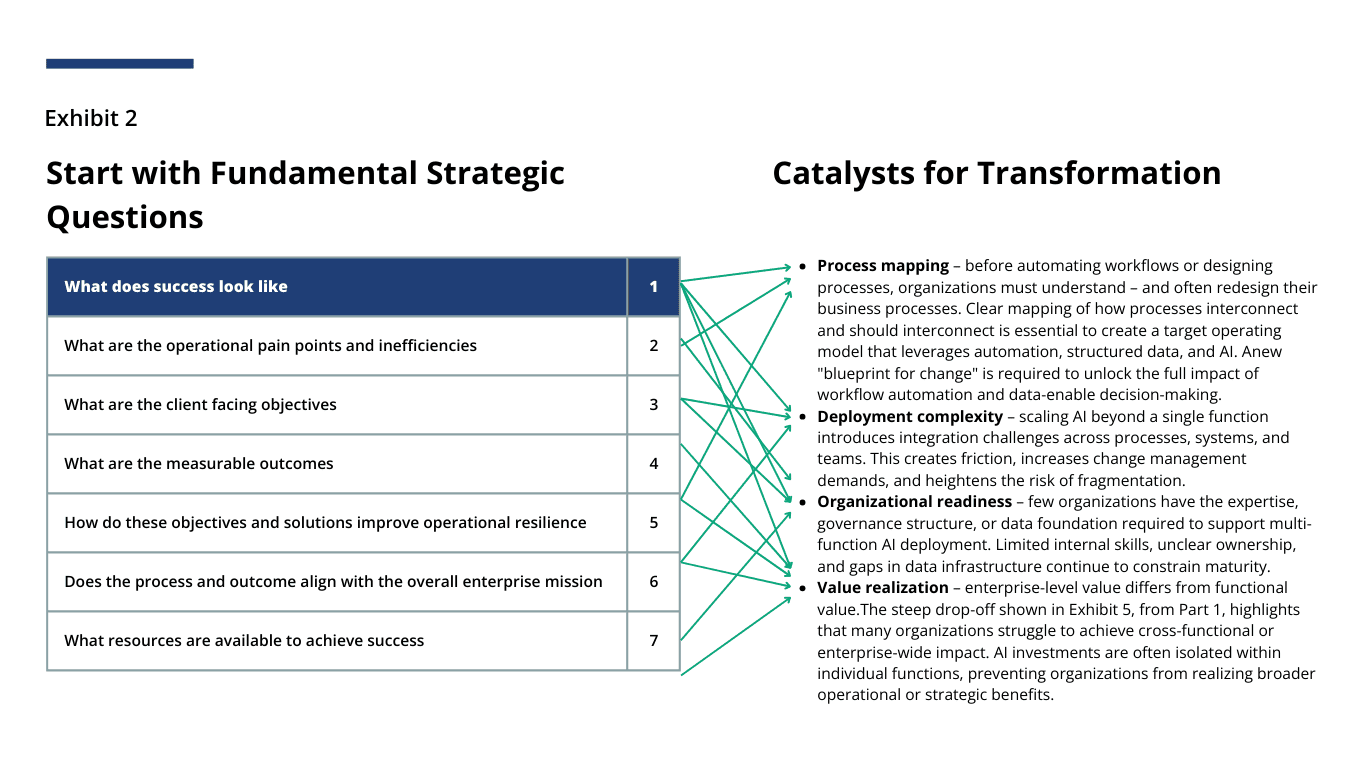
This “AI gap” is less about access to technology and more about strategic execution. CRE leaders often face fragmented data environments, siloed functions, and legacy operating models that were never designed for real-time decision-making. To close this gap, organizations must first define what success looks like from identifying functional pain points, to operational inefficiencies, and client-facing objectives that AI can improve. When technology strategy, operating model, and business intent are aligned, AI becomes not just a tool for automation, but a catalyst for performance transformation.
This part of the series explores how to help clients bridge that divide, developing AI strategies grounded in measurable outcomes, operational resilience, and alignment with the enterprise’s overall mission.
Mind the Gap and Bridge the Divide
In Part 1 we outlined the emerging AI trends in CRE, the realities of adoption, and why many organizations struggle to convert potential into performance.
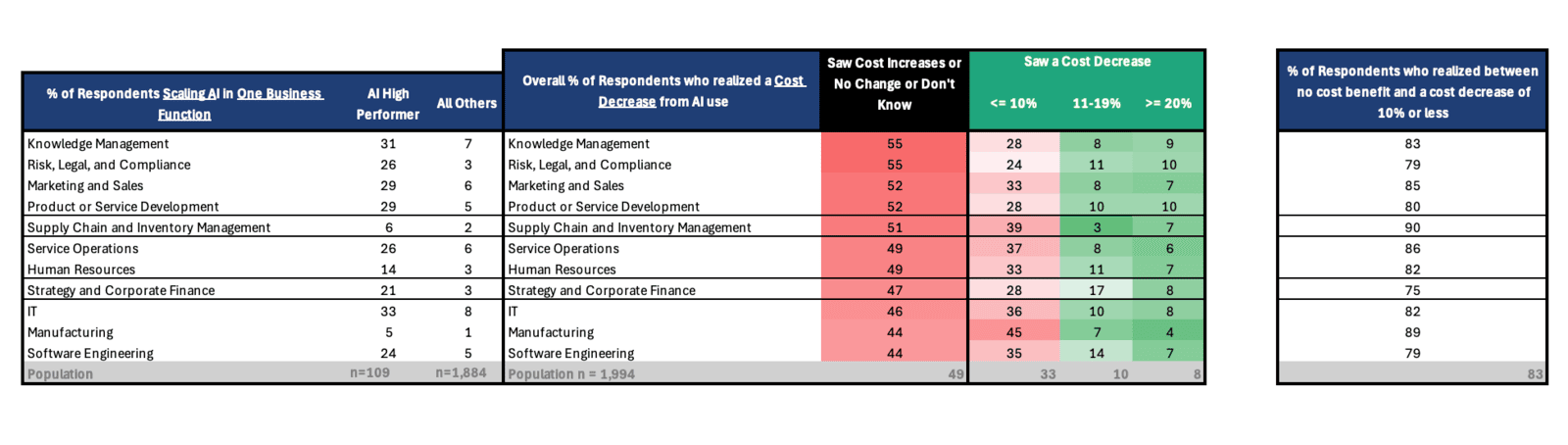
The data shows that most organizations have yet to unlock meaningful efficiency gains from AI see (Exhibit 1). In 2025, across all major business functions, roughly half of 1,994 respondents reported either higher costs, no change in cost savings, or an inability to quantify AI’s savings impact. About one-third saw cost benefits of 10% or less, 10% reported a cost benefit of 11-19%, and only 8% realized savings of 20% or more. When grouping the results into a single band, from no cost benefit up to 10% savings, more than 80% of respondents fall into this category.
Percentage of respondents scaling AI agents to improve efficiency and realizing a cost decrease
Given how few organizations are capturing meaningful gains, the path forward hinges on turning potential into practice through a focused implementation strategy. One that tackles organizational, process, and resource barriers. To close the gap between today’s capabilities and the business objectives of tomorrow, CRE organizations must confront several foundational strategic questions:
Aligning Technology Strategy, Operating Model, and Business Intent
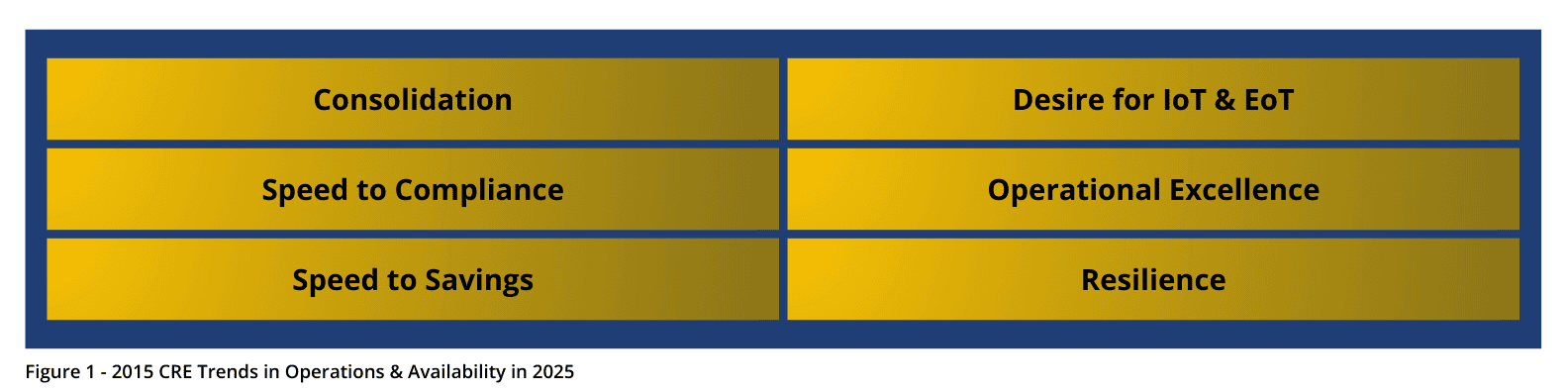
A decade ago, in 2015, the prevailing global CRE trends in operations were focused on addressing the key areas in Efficiency, Growth, and Innovation. See Figure 1 below.
Ironically, the same trends are still relevant, pervasive, and continue to be a challenge in current organizations. When we speak of converting potential into performance, these gold nuggets represent new AI opportunities and solutions that are addressable to unlock previously un obtained efficiencies, growth, and innovation in target operating models.
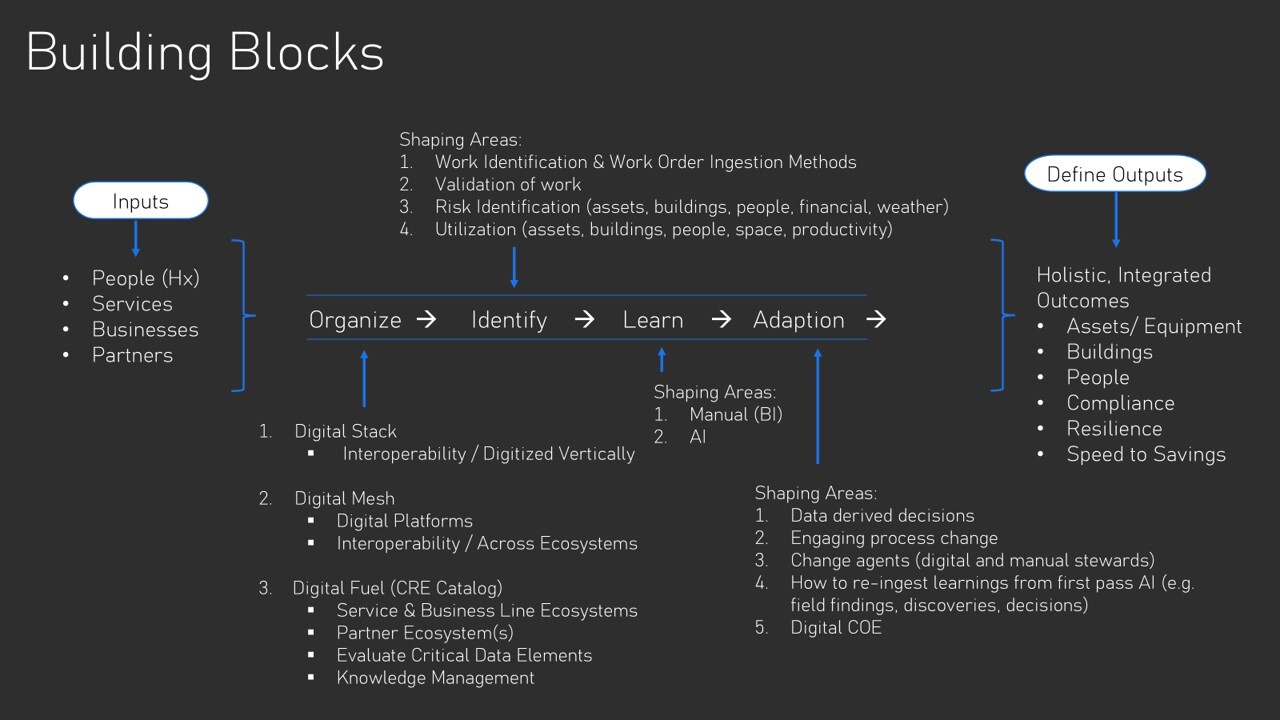
For organizations, unlocking the next wave of AI value starts with fixing the CRE foundation. Legacy structures with organizational silos, fragmented infrastructure ownership, inconsistent processes, and constrained resources cannot be solved by a “single AI solution”. Achieving outcomes like compliance, operational excellence, and resilience requires redesigning the full value chain – how inputs are organized and how they are translated into measurable performance. The outputs or outcomes sit on top of strong structural inputs such as integrated data from human experience, service operations, partner networks, contracts, and building level technology to name a few.
Figure 2 presents an example, as a set of foundational building blocks and strategic levers that guide how organizations evaluate their operational baseline, formulate and architect execution, and building AI enabled solutions in CRE. Automation is only effective if key elements are in place-- including providing a clear structure for defining use cases, understanding the value chain, reducing the complexity, and linking inputs to their outcomes to ultimately define success.